
Fleshy and Eager: On Risk, An Octopus, and Connection
Every so often, a piece of media arrives in perfect alignment with the life I am living. This is an essay about Remarkably Bright Creatures, risk, isolation, and the difficult, necessary work of choosing connection.
May 27, 2026
Every so often I consume a piece of media and it feels in perfect alignment with the period in my life. I consume—TV, movies, books, articles, Instagram, everything. I work in communication and “staying on top of trends” is always listed in the job description, but I think I would engage this way regardless. Movies, books, TV shows have all modeled for me what risk costs and what makes it worth it.
I grew up with parents who loved entertainment. My mother always played music, loved weekly movie nights, had a room full of thriller books. My father had every Sony sound system and media player known to man. I grew up watching laser discs and listening to recordings on reel-to-reel sound systems. When they divorced, I grew up in homes where the people who ran them were moved by human connection and creation, even when they could not make that connection sustain in their personal lives.
It fundamentally shaped me—I have a heart open to being changed by someone else's magic.
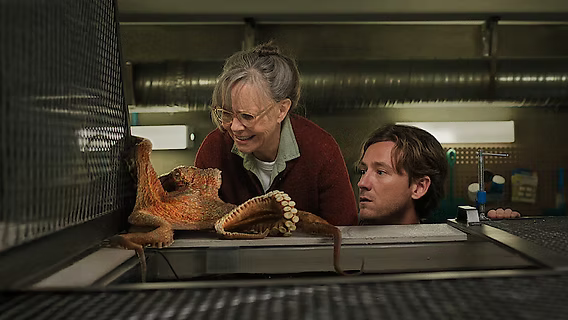
an image of Marcellus the octopus from Remarkably Bright Creatures with his tentacle in Tova’s hand at the top of his open tan
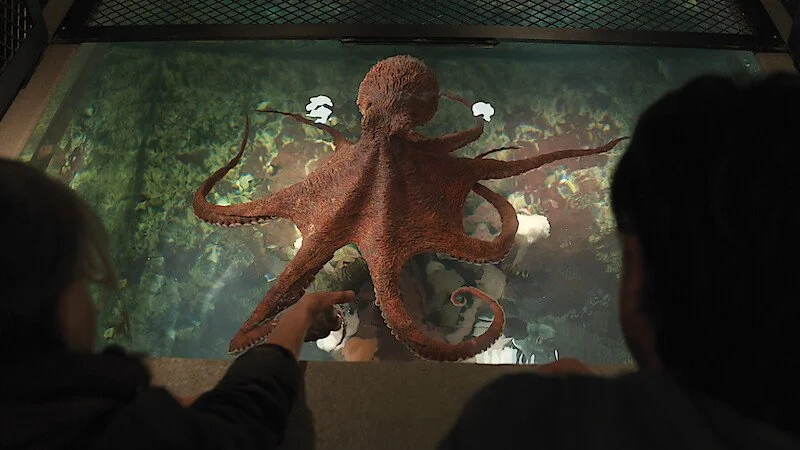
This week I find myself moved by an octopus and an old woman in a white town that would probably make me uncomfortable as fuck in real life, with its small-town optimism, whiteness, and wealth, but on my screen is unassuming and filled with lessons. Remarkably Bright Creatures is a wildly successful novel turned film. You watch an octopus, Marcellus, understand his life is coming to an end in captivity as he observes the complicated, fluctuating nature of the humans around him, who seem kind of dim. He discovers the depth of trauma within his preferred human, a late-night widow named Tova, who cleans the aquarium he lives in.
Tova is a widow who has opted out of living fully, sharing her secrets with Marcellus while she cleans his tank. Cameron, the secondary character, is a man undone by the death of his mother, the loss of his band, and the absence of a father he cannot find. He becomes her problem after she sprains her ankle and he takes over her job. He half-asses everything; she teaches him how to do things properly. They are both traumatized, rubbing against each other, scratching each other in moments of tension where intimacy feels like a threat to the lives they’ve already survived. There is enormous familial loss, the grief of what feels like an empty life, a man who is stuck and a life that shows it.
It fundamentally shaped me—I have a heart open to being changed by someone else’s magic.
I have always identified with the big moments in movies—the ones where everything fractures at once. My life has held its own versions: interpersonal chaos, violence, the slow-burn existential crises that make up adulthood. If you compressed it all into something cinematic, it would feel excessive—like a story trying too hard to be believed.
The scar on my right palm is one of those moments. Glass, stitches, the end of my marriage. Six years collapsing into something sharp and immediate: arguments, disappointments, failed attempts at change, the familiar choreography of harm. When it ended, I convinced myself I was done with intimacy. I called it asexuality. I called it clarity. It was, more honestly, control—risk mitigation disguised as self-knowledge.
Isolation was comfortable. Video games offered dopamine and social engagement without real risk. Unanswered phone calls couldn’t intrude on my solitude with questions that demanded reflection. Patterns I thought survival would wear down are still embedded in my brain, asking if risk is worth the loss. Tova loses her son and husband and shuts down her whole life. Cameron searches for a past that might make him want a future. In Tova’s withdrawal, I see my chosen solitude. In Cameron’s search, I see my own re-entry into human connection. I am reminded these intimacies are at the core of living. I am asked again: will it be worth the hurt?
Sometimes the question genuinely makes me stumble—I have a brave spirit but a fearful heart.
I spent three months successfully isolated. When I tried to seek connection through an app, or five, it offered a shallow solution for a very human desire to feel something safe. Faces blurred together, conversations stalled in the same places, intimacy flattened into something performative and easily abandoned. I could participate without ever really being touched by it. Interest without investment. I could feel myself becoming legible in the ways that are rewarded there: easy, responsive, contained. Safe in a way that required very little of me.
I see the impact of colonialism and capitalism in spaces like this—where people become profiles, where desire is filtered into preference, where connection is optimized for ease. We are taught to be legible, palatable, self-contained. To want without needing too much. To engage without disrupting our own sense of control. In that kind of world, intimacy starts to feel like a liability.
Then history reared up and showed me my heart, while scared, is still fleshy and eager. A person I could feel safe with reminded me what pleasure without coercion felt like from head to toe. My commitment to solitude, to celibacy, was interrupted by my capacity to move beyond fear and another’s willingness to risk something with me. So beautifully human.
In that kind of world, intimacy starts to feel like a liability.
All around me I feel the crushing weight of homogenization shaped by colonialism and capitalism. I see it in the way our lives are structured around efficiency and palatability—how we are taught to smooth ourselves out to be easier to understand, easier to consume. Difference becomes inconvenient. Slowness becomes failure. Care becomes optional. We inherit systems that reward distance from one another while quietly punishing the vulnerability required for real connection.
There is such an emphasis on sameness, ease, and the self that learning how to be different with someone else becomes an expert-level practice. We are offered things—purchases, materials, monetary comforts—in place of the skills required to engage each other gently. Individualism as a strength is a fabrication of this version of our society that isolates us from the complex inner worlds of those around us.
As you watch Remarkably Bright Creatures, Tova and Cameron slowly share their traumas, revealing why he is a grown, incompetent man and she is a closed-off elder working the night shift to avoid a life shared with others. These moments show the work required to build real relationships—work done individually, but also together, in negotiation with fears, histories, and feeling. They fight; memory makes them too sensitive to the touch, and yelling feels like flinching. When loss and hurt are fundamental to human existence, we have to learn grace without self-betrayal to build something beyond ourselves.
I am, demographically, nothing like these white, middle-class characters. Yet I share deeply in their humanity. As we tell our stories, we uncover how similar our experiences are—the soft, fleshy parts of us buried under violence, expectation, and the fear that connection might cost more than we can survive. Every day we wake up to risk—structural, interpersonal, within ourselves—and decide how we are capable of engaging. This movie reminded me that I am willing to be uncomfortable, even if some days I am better at it than others, to build a life where I do not run from the potential harm of risk, but toward its potential meaning.
